What is the IGCSE? The Complete Guide (2026)

Sir Faraz Hassan
Published 5 Jul 2026 · Updated 23 Sept 2026

Table of Contents▾
The International General Certificate of Secondary Education, or IGCSE, is the world's most widely taken international qualification for 14 to 16 year olds. It is the global sibling of the UK's GCSE: same academic level, same university recognition, but designed to be taught in any country. Over 150 countries run IGCSE programmes, and if you are at an international school in Dubai, Abu Dhabi, or almost anywhere outside the UK, the IGCSE is very likely the qualification your school follows.
I have spent over ten years teaching IGCSE and GCSE Mathematics to more than 500 students across Edexcel, Cambridge and AQA, and the same questions come up in almost every first conversation with a parent: What exactly is the IGCSE? Is it harder than the GCSE? Which exam board does my child's school use, and does it matter? This guide answers all of it, from a Maths specialist's perspective, updated for the 2026 exam series.
How the IGCSE Works
The IGCSE is a two-year course, usually taught across Years 10 and 11, when students are roughly 14 to 16 years old. Most students take between five and ten subjects, with Mathematics, English and at least one science forming the core almost everywhere. Each subject is examined separately and awarded its own grade, so a student leaves with a set of individual IGCSE qualifications rather than a single combined result.
Assessment is overwhelmingly exam based. Unlike some national systems that lean on coursework or continuous assessment, the IGCSE is judged almost entirely by final written papers sat at the end of Year 11. For Mathematics specifically, there is no coursework at all: your grade comes purely from the papers you sit in the exam hall. This makes exam technique and timed practice unusually important, a point I return to at the end of this guide.
Tiers: the decision most parents overlook. Most IGCSE subjects, including Mathematics, are split into two tiers of entry, and the tier a student is entered for sets a ceiling on the grade they can achieve. Cambridge calls its tiers Core and Extended; Edexcel calls them Foundation and Higher. The Core or Foundation tier covers the lower part of the grade range and caps the top grade available, while the Extended or Higher tier reaches all the way up to the highest grades. Choosing the right tier is one of the most consequential decisions in the whole IGCSE journey, and it is often made quietly by the school with little discussion.
IGCSE Exam Boards: Cambridge vs Edexcel
Two exam boards dominate IGCSE Mathematics worldwide. The first is Cambridge, whose international arm, Cambridge Assessment International Education, introduced the IGCSE back in 1988 and still runs the most widely recognised version. Its Mathematics syllabus, coded 0580, is the one you will find at many of the best IGCSE schools in Dubai such as Repton, Kings' and GEMS Wellington.
The second major route is Pearson Edexcel, whose International GCSE in Mathematics carries the specification code 4MA1. Edexcel is a British board with a large international footprint, and its 4MA1 qualification is a genuine alternative to Cambridge rather than a lesser one. If you want a deeper comparison of how the two boards differ in structure and difficulty, I have written a full breakdown, along with a dedicated guide to the 4MA1 specification itself.
The two boards are equal in standing. A university admissions officer treats Cambridge 0580 and Edexcel 4MA1 as equivalent qualifications. They are not, however, identical to sit. The clearest difference is the calculator policy: Cambridge includes a non-calculator paper in its assessment, whereas Edexcel 4MA1 allows a calculator on every paper. That single difference changes how you prepare, because a non-calculator paper rewards mental arithmetic and exact working in a way that a fully calculator paper does not.
One point of confusion is worth clearing up. AQA is a major exam board inside the UK, but its main Mathematics qualification is the national GCSE, not an IGCSE. There is an international version offered under the Oxford AQA name, but it is far less common in Dubai, Abu Dhabi and the wider Gulf than Cambridge or Edexcel. In practice, if a student sits an IGCSE in this region, it is almost certainly Cambridge or Edexcel.

IGCSE vs GCSE: The Real Differences
Parents often assume the IGCSE is a watered down or lower status version of the GCSE, or that it carries less weight with universities. Neither is true. The IGCSE and the GCSE sit at exactly the same academic level and are treated identically by universities and employers. They are the same level qualification with different design choices.
GCSE
- Availability
- UK and a few countries
- Assessment
- 100% exam, 3 papers incl. non-calculator
- Grading
- 9-1
- Exam series
- May-June, Nov resits
IGCSE
- Availability
- 150+ countries
- Assessment
- 100% exam, 2 papers, calculator rules vary by board
- Grading
- 9-1 or A*-G
- Exam series
- May-June and November, plus February-March in India (Cambridge)
One myth needs correcting directly, because it comes up in almost every conversation. Many parents believe the GCSE involves coursework while the IGCSE does not, and that this makes the IGCSE the harder route. For Mathematics this is simply false. GCSE Mathematics does not include compulsory coursework either; like the IGCSE, it is assessed entirely by final written examinations. In Maths, the coursework distinction that people imagine between the two qualifications does not exist.
Grading Explained: 9-1 and A*-G
IGCSE Mathematics is graded on one of two scales, depending on the board and the specific syllabus. Pearson Edexcel 4MA1 uses the numerical 9 to 1 scale, where 9 is the highest grade, the same scale used by the reformed UK GCSE. Cambridge is more nuanced: its 0580 syllabus reports on the traditional A* to G letter scale, while its 0980 syllabus reports on the 9 to 1 numerical scale. The content is the same; only the grading scale differs.
As a rough map between the scales, grade 9 is a new top grade awarded to fewer students than the old A* was, grade 7 starts where the old A started, and grade 4, the standard pass, starts where the old C started. The exact marks needed for each grade are not fixed in advance. They are set after each exam series through grade boundaries, which shift up or down a few marks each year to keep standards consistent when a paper turns out slightly harder or easier.
150+
Countries offering IGCSE
A* / 9
Top grade: A* (Cambridge 0580), 9 (Edexcel 4MA1)
4
Standard pass grade
Who Should Take the IGCSE?
For most families outside the UK, the IGCSE is not really a choice; it is simply the qualification their school offers. International schools across the Gulf, Asia, Africa and Europe run IGCSE programmes because the qualification is designed to travel across borders and is understood by universities everywhere. If your child attends one of the best IGCSE schools in Dubai and Abu Dhabi, the IGCSE pathway is already set for them.
The IGCSE also suits students who may move countries during their education, or who plan to apply to universities internationally. Because it is recognised in the UK, across Europe, in North America, the Middle East and Asia, it keeps every door open. A student who completes IGCSEs in Dubai can apply to a British university, an American college or a local one on equal footing. That portability, more than anything, is why the qualification has spread to over 150 countries.
How to Prepare for IGCSE Maths (an Examiner's View)
Preparing for IGCSE Maths is not mysterious, but it is specific. After teaching and marking these papers for over a decade, I would give any student the same four priorities.
Know your exact syllabus
Cambridge 0580 and Edexcel 4MA1 are not the same. Find your board and syllabus code, download the specification, and learn exactly which topics are examinable for your tier. Studying a topic that is not on your paper is wasted effort, and missing one that is can cost a grade.
Past papers are the syllabus
The single most reliable way to prepare is to work through past papers under timed conditions. The boards reuse question styles year after year, so after ten or fifteen papers you will recognise almost every question type before you have finished reading it. Mark your own work against the official schemes so you learn what earns the marks.
Collect method marks deliberately
IGCSE Maths papers award marks for correct method even when the final answer is wrong. Always show your working line by line. A student who writes out each step banks two or three marks on a question they cannot finish, while a student who writes only the answer gets nothing for the same thinking.
Fix the algebra first
Algebra underpins almost every other topic, from graphs to trigonometry to coordinate geometry. If your algebra is shaky, everything built on top of it wobbles. Before anything else, get fluent with expanding, factorising, rearranging and solving. It is the highest leverage investment you can make in your grade.
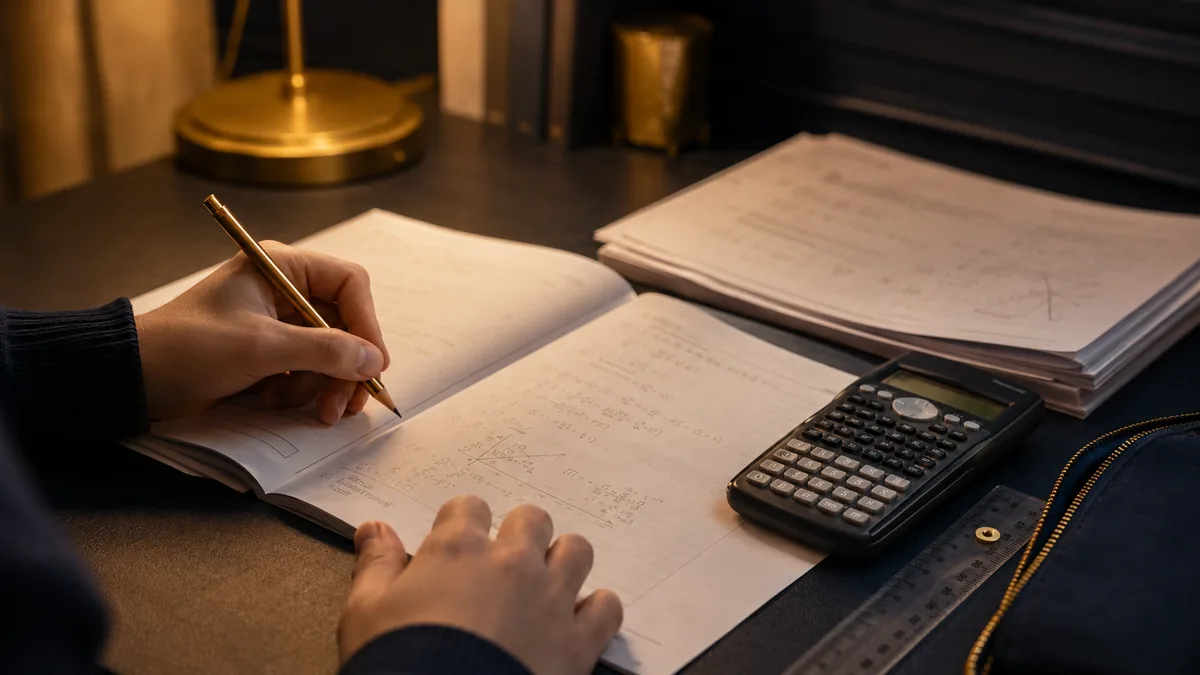
If you want to put this into practice, our interactive Maths Studio gives you timed, exam-style practice with instant feedback, and for students who want structured, one-to-one guidance through the whole syllabus, I offer specialist IGCSE Maths tutoring built around exactly these priorities. If you are on Edexcel, the worked solutions to 4MA1 Paper 1F, November 2024 show what earns each mark across all 27 questions.
Frequently Asked Questions
IGCSE stands for International General Certificate of Secondary Education. It is an academic qualification for students aged roughly 14 to 16, equivalent in level to the UK GCSE but designed to be taught in schools all over the world.
No. The IGCSE and the GCSE sit at the same academic level and are graded to the same standard. For Mathematics the content overlaps almost completely. Any perceived difference in difficulty usually comes down to the exam board, the tier of entry and the specific paper, not the IGCSE label itself.
Neither is better; they are equal in standing and recognition. The main practical difference is that Cambridge 0580 includes a non-calculator paper while Edexcel 4MA1 allows a calculator throughout. Most families take whichever board their school offers, and both prepare students equally well for further study.
Yes. The IGCSE suits private candidates, including home-educated students, because Maths is assessed entirely by final exams with no compulsory coursework. You register through an approved exam centre, which can be a school or a dedicated centre, and sit the papers there in the normal exam series.
There is no single official pass mark, but a grade 4 on the 9 to 1 scale, or a grade C on the A* to G scale, is widely treated as a standard pass. Many competitive sixth forms and universities ask for a grade 5, 6 or higher in Mathematics, so aim above the minimum if you have a specific course in mind.
Most students take between five and ten IGCSE subjects. A common pattern is around eight, always including Mathematics, English and at least one science. Quality matters more than quantity: strong grades in a solid set of subjects are far more valuable than many weaker passes.
Ready to boost your grades?
Get expert 1-to-1 tutoring in GCSE & IGCSE Maths. Book a free 30-minute intro session to see the difference.
Book Free 30-Min Intro Session